Key Takeaways: Supreme Court Upholds Constitutional Validity of Section 16(2)(c) Denying ITC for Suppliers Non-Payment of Tax
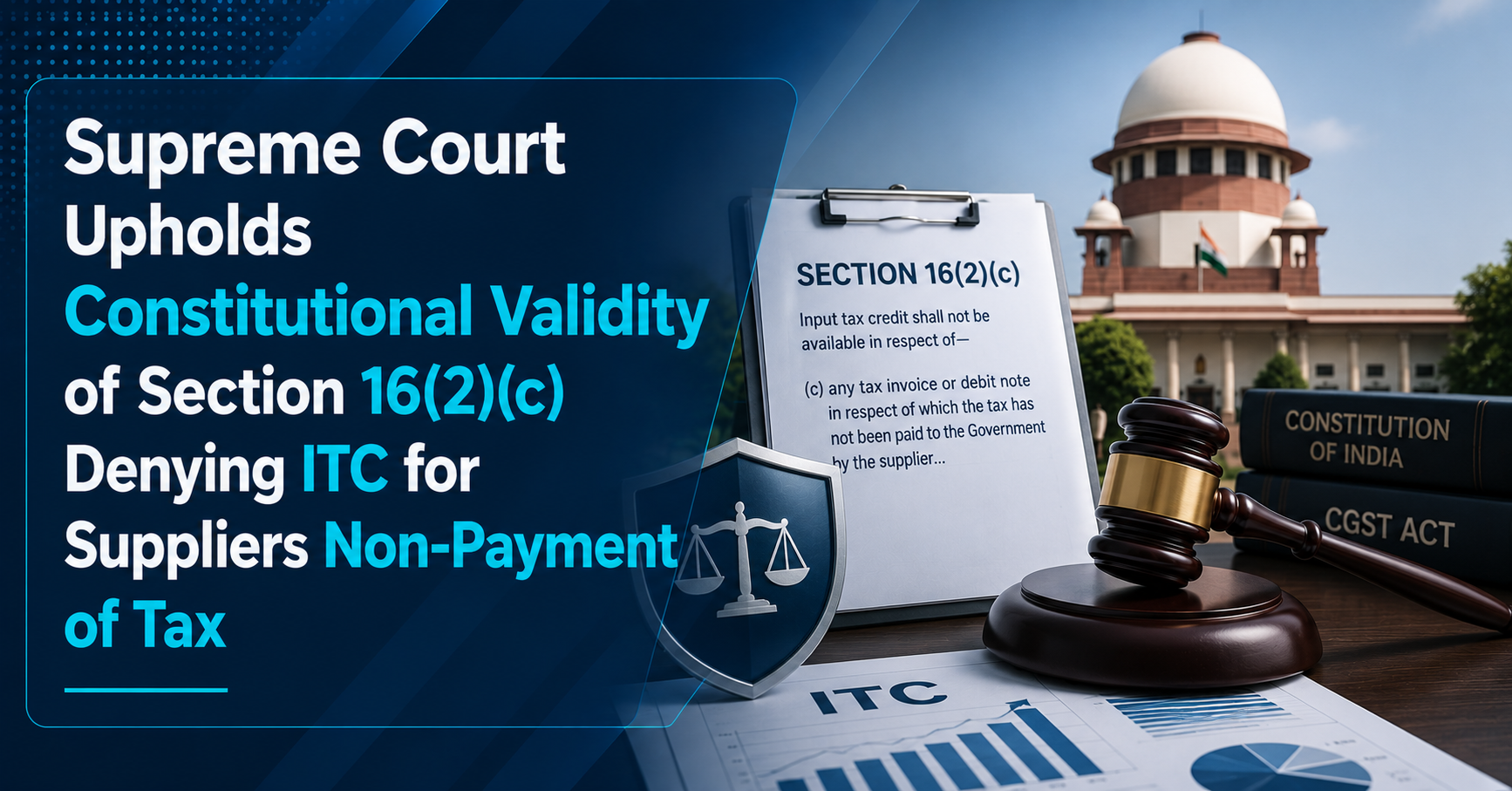
Supreme Court Upholds Section 16(2)(c) on GST Input Tax Credit
The Supreme Court has upheld the constitutional validity of Section 16(2)(c) of the Central Goods and Services Tax (CGST) Act, 2017, confirming that a recipient's entitlement to Input Tax Credit (ITC) is subject to the supplier actually paying the tax to the Government.
Background of the Case
In Bhandari Scrap Traders v. Union of India & Ors., SLP (C) No. 23931 of 2026 and connected matters, the Supreme Court dismissed the Special Leave Petitions on 24 July 2026. The Court affirmed the Gujarat High Court's decision in Maruti Enterprise v. Union of India & Ors., which had upheld Section 16(2)(c).
The purchasing dealers argued that denying ITC because of a supplier's default was unfair where the purchaser had acted in good faith. They also challenged the provision on constitutional grounds under Articles 14, 19(1)(g), 265 and 300A.
The petitioners alternatively requested that Section 16(2)(c) be read down so that ITC could be denied only where the transaction involved fraud, collusion or connivance between the supplier and purchaser. The Gujarat High Court rejected these arguments, leading to the appeal before the Supreme Court.
What Does Section 16(2)(c) Provide?
Section 16(2)(c) of the CGST Act makes ITC subject to the condition that the tax charged on the supply has actually been paid to the Government, either in cash or through utilisation of eligible input tax credit.
Therefore, merely possessing a tax invoice does not, by itself, remove the statutory conditions governing ITC.
The Supreme Court agreed with the Gujarat High Court that ITC is a statutory benefit and not an unconditional or vested constitutional right. Parliament is entitled to prescribe conditions for claiming such credit.
Supreme Court's Key Findings
The Supreme Court found no basis to declare Section 16(2)(c) unconstitutional or to read additional limitations into the provision.
Importantly, the statutory framework contains mechanisms for reversal and subsequent re-availment of credit. The Gujarat High Court had considered the interaction of Section 16(2)(c) with provisions including Section 41 and Rule 37A of the CGST Rules. Rule 37A provides a mechanism for reversal of ITC in specified circumstances and its subsequent re-availment when the supplier fulfils the prescribed return-filing requirement.
Thus, the Court accepted that the statutory scheme does not necessarily result in a permanent loss of credit merely because the supplier has temporarily failed to discharge the relevant tax obligation.
What Does This Mean for Businesses?
The judgment makes supplier compliance an important consideration in managing GST credit risk.
Businesses should:
- Conduct appropriate GST compliance checks on suppliers.
- Regularly reconcile purchase records with GST portal data.
- Monitor supplier return-filing compliance.
- Maintain invoices, proof of receipt of goods or services and payment records.
- Review ITC that may require reversal under the applicable statutory mechanism.
- Track reversed credit so that eligible ITC can be re-availed when the statutory conditions are subsequently satisfied.
At the same time, the Supreme Court's decision should not be understood as creating an independent obligation for every purchaser to obtain the supplier's private tax-payment records. The manner in which Section 16(2)(c) operates must be considered together with the statutory compliance and ITC framework.
Conclusion
The Supreme Court's decision in Bhandari Scrap Traders provides significant clarity on the constitutional validity of Section 16(2)(c) of the CGST Act. ITC remains a conditional statutory benefit, and the supplier's discharge of the relevant tax liability continues to be an important statutory requirement.
Businesses should therefore strengthen vendor due diligence and GST reconciliations to reduce the risk of ITC disputes and ensure timely compliance.
For expert guidance on this topic, contact your tax professional today.
Have Questions? We're Here to Help
Get expert advice from TAX AVIJIT. Reach out to discuss your requirements.