
GSTAT Benches Officially Constituted Across India
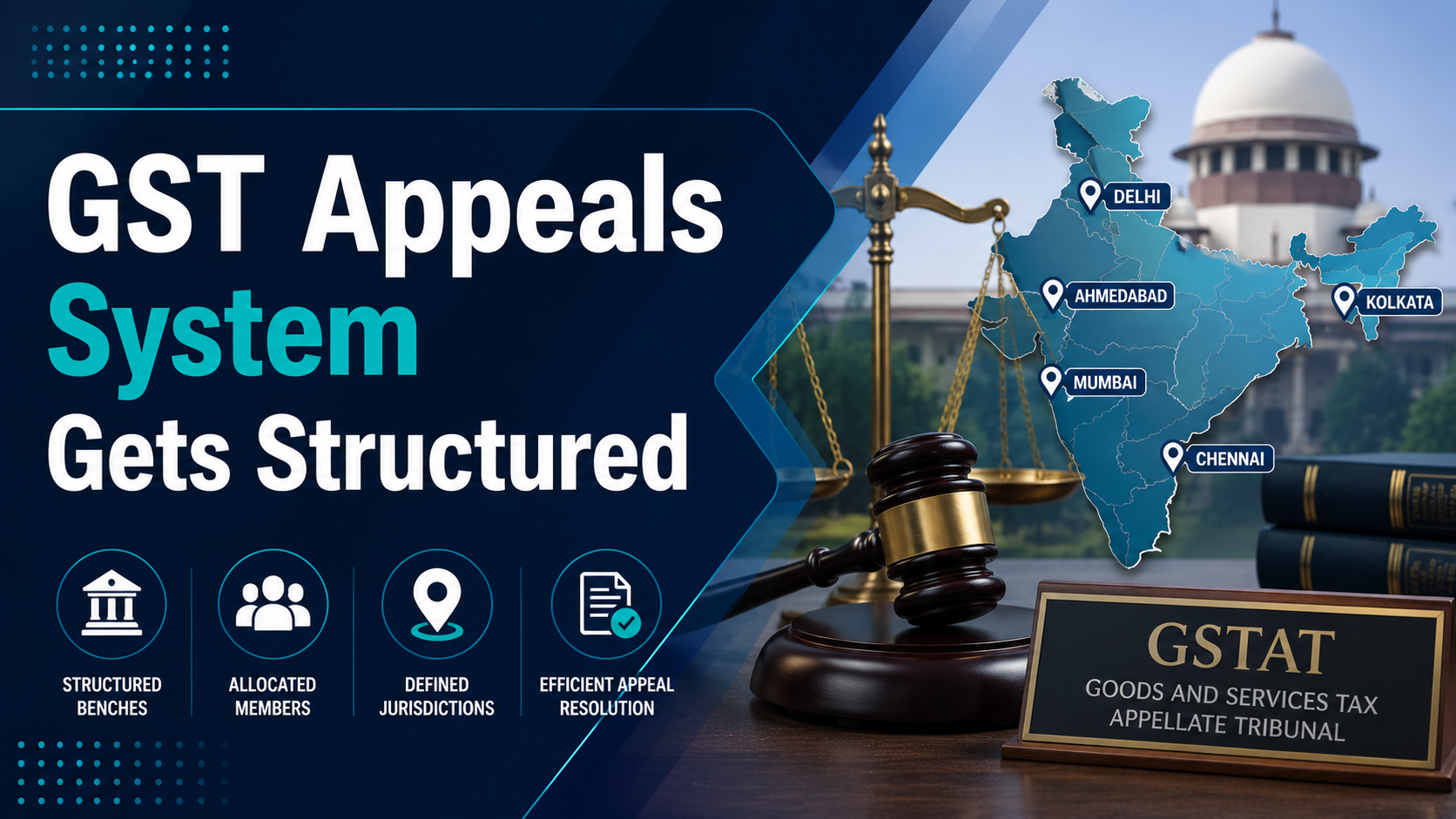
The Government has officially operationalised the Goods and Services Tax Appellate Tribunal (GSTAT) framework by constituting benches across multiple states and cities in India. This marks a significant development in the GST dispute resolution mechanism and is expected to streamline the disposal of pending GST appeals.
The notification also provides classification of appeals into different categories and allocates Judicial and Technical Members bench-wise for adjudication.
What is GSTAT?
The Goods and Services Tax Appellate Tribunal (GSTAT) is the second appellate authority under the GST regime established under:
- Section 109 of the Central Goods and Services Tax Act, 2017.
The Tribunal hears appeals against orders passed by:
- Appellate Authorities, and
- Revisional Authorities under GST laws.
Before GSTAT became operational, taxpayers had limited appellate remedies, resulting in substantial litigation before High Courts.
Key Highlights of the Notification
The Government has now:
- Constituted GSTAT benches across various states and cities;
- Allocated Judicial Members and Technical Members to different benches;
- Classified GST appeals into specific categories for administrative and judicial efficiency.
This is a major step toward fully implementing the GST appellate framework originally envisaged under the GST law.
Classification of Appeals
The order categorises GST disputes broadly into:
Category I
Generally includes matters involving:
- Classification disputes,
- Input Tax Credit issues,
- Refund matters,
- Demand and recovery proceedings.
Category II
Typically covers:
- Procedural and compliance-related disputes,
- Registration matters,
- Transitional credit issues,
- Return filing disputes.
Category III
Usually relates to:
- Complex legal interpretation,
- High-value disputes,
- Multi-jurisdictional GST issues,
- Matters requiring special bench consideration.
The categorisation aims to improve case management and expedite hearings.
Composition of GSTAT Benches
Each bench generally consists of:
- One Judicial Member, and
- One Technical Member.
The Government has notified bench-wise allocation of members for hearing GST disputes in different jurisdictions.
This structure is intended to ensure:
- Balanced judicial and technical expertise,
- Faster disposal of appeals,
- Uniformity in GST jurisprudence across India.
Importance for Taxpayers and Businesses
The operationalisation of GSTAT is expected to provide major relief to businesses facing GST litigation.
Key benefits include:
- Faster disposal of pending GST appeals;
- Reduced burden on High Courts;
- Specialised forum for GST-related disputes;
- Improved consistency in tax interpretations;
- Better access to appellate remedies for taxpayers.
Businesses involved in:
- ITC disputes,
- Classification issues,
- Refund claims,
- GST demand notices,
- Penalty proceedings,
may now benefit from a dedicated appellate structure.
Practical Compliance Impact
Taxpayers should now:
- Review pending appellate matters;
- Track jurisdictional GSTAT bench allocation;
- Prepare documentation and appeal records carefully;
- Monitor limitation timelines for appeals before GSTAT.
Businesses should also consult tax professionals regarding litigation strategy and procedural requirements under the newly operational tribunal system.
Conclusion
The constitution of GSTAT benches across India is a landmark development in the GST regime. It is expected to significantly improve the efficiency, speed, and consistency of GST dispute resolution while strengthening taxpayer confidence in the appellate system.
For expert guidance on this topic, contact your tax professional today.
Have Questions? We're Here to Help
Get expert advice from TAX AVIJIT. Reach out to discuss your requirements.